
Tree Leaning More After a Storm? How to Tell If the Roots Failed
July 20, 2026
WARNING: Never push on, prune, or stand under a leaning tree with cracked soil or lifted roots on one side. It can drop with almost no warning, and getting close to inspect it is how people get hurt. Have it checked from a safe distance.
WARNING: Never push on, prune, or stand under a leaning tree with cracked soil or lifted roots on one side. It can drop with almost no warning, and getting close to inspect it is how people get hurt. Have it checked from a safe distance.
Quick Answer: A tree that leans more after a storm often means the root plate on one side has torn free of the soil, which is very different from a tree that has grown at an angle its whole life. Watch for a lean that appeared or worsened suddenly, cracked or raised soil on one side of the trunk, and roots lifting out of the ground. A new lean toward a house, driveway, fence, or power line should be treated as a possible failure in progress and looked at by a certified arborist before anyone tries to straighten, stake, or brace it.
You walk the property the morning after a line of storms rolls through, and the big oak near the driveway looks wrong. It is tilted further than you remember, the mulch on one side is broken and pushed up, and a few surface roots that used to sit flush with the ground are now standing proud. Maybe it moved a lot, maybe just a little, but your gut tells you the tree shifted overnight. That instinct is worth trusting.
A tree that leans more after wind and rain is telling you something happened underground, where you cannot see it. The part that holds a tree upright is not the trunk, it is the root plate, the wide mat of roots and soil that anchors the base. When that plate tears loose on one side, the tree starts to tip, and every storm after that can push it further. The trick is knowing the difference between a tree that has always leaned and one whose anchor just failed. Here is how you read it.
A Lean That Always Existed Is Not the Same as a New One
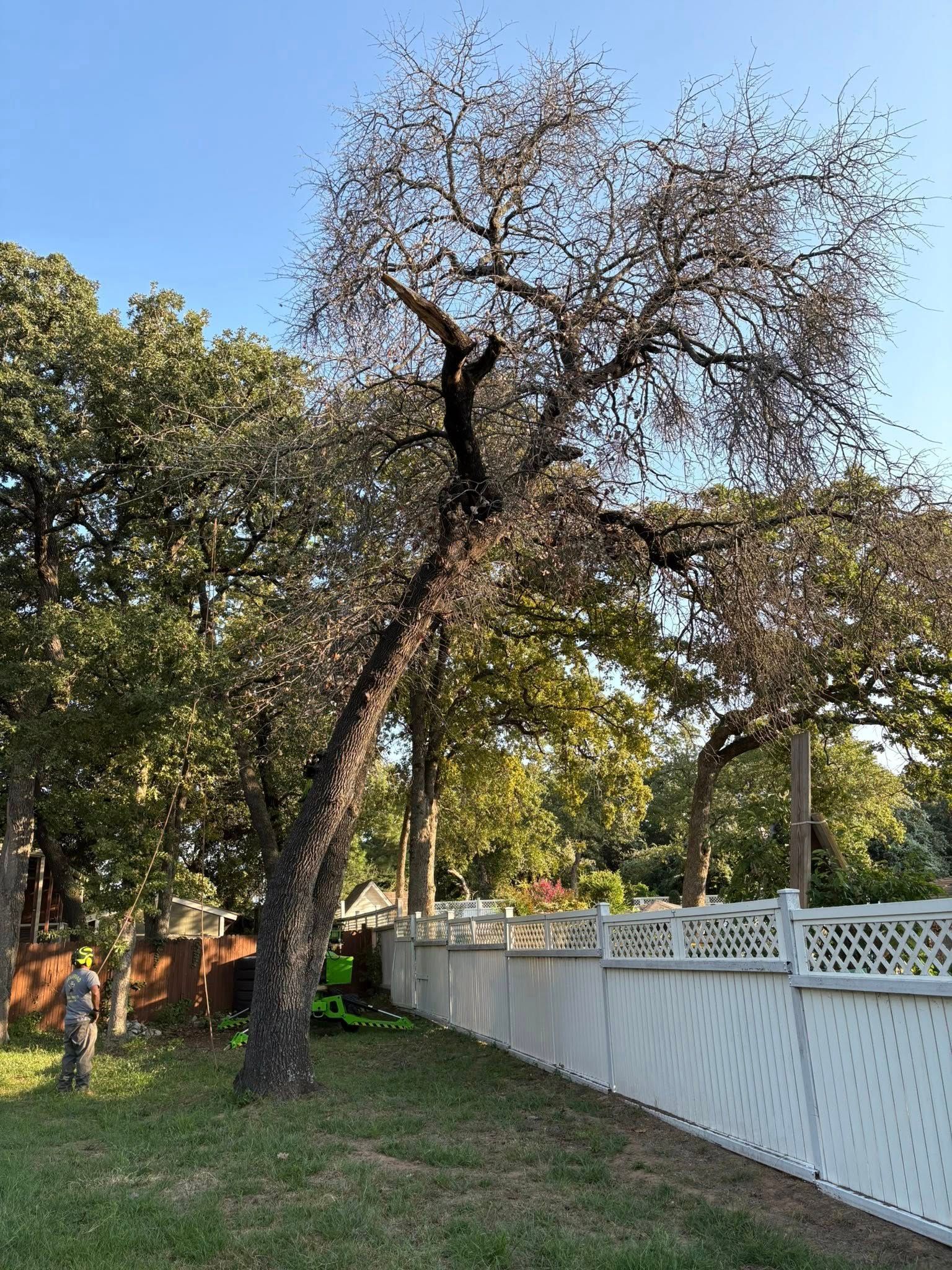
The first question to settle is whether the lean is old news or brand new. Plenty of trees grow at an angle their entire lives and stand perfectly stable. A tree that reached sideways for light for twenty years, curving around a building or out from under taller neighbors, has built its wood and root system to hold that shape. That kind of lean, unchanged season after season, is usually not the problem.
A lean that showed up or worsened suddenly
The concern is movement. A tree that was vertical last week and is tilted this week, or one whose familiar angle got noticeably steeper after a storm, is behaving like a tree in the early stage of failure. Sudden change means the roots or the soil holding them gave way, and the tree is now leaning on whatever anchorage is left.
A trunk that curves versus a whole tree that tips
Look at the shape. A tree that curves along its trunk but whose base sits firmly in undisturbed ground grew that way over time. A tree that is straight but tipping from the base, with the entire trunk pivoting off the ground line, is moving at the roots. The base is where the answer lives, so that is where your attention belongs.
A tree you can compare to a fixed point
If you are unsure whether it moved, sight the trunk against a corner of the house, a fence post, or a doorframe from the same spot each day. A lean that keeps opening up against that reference over days or weeks is a lean that is still failing, not one that has settled.
The Root Signs That Say the Anchor Gave Way
Once you suspect a new lean, the ground around the base tells the real story. Root failure leaves marks at the surface, and they are easier to read than most homeowners expect.
Cracked or raised soil on one side of the trunk
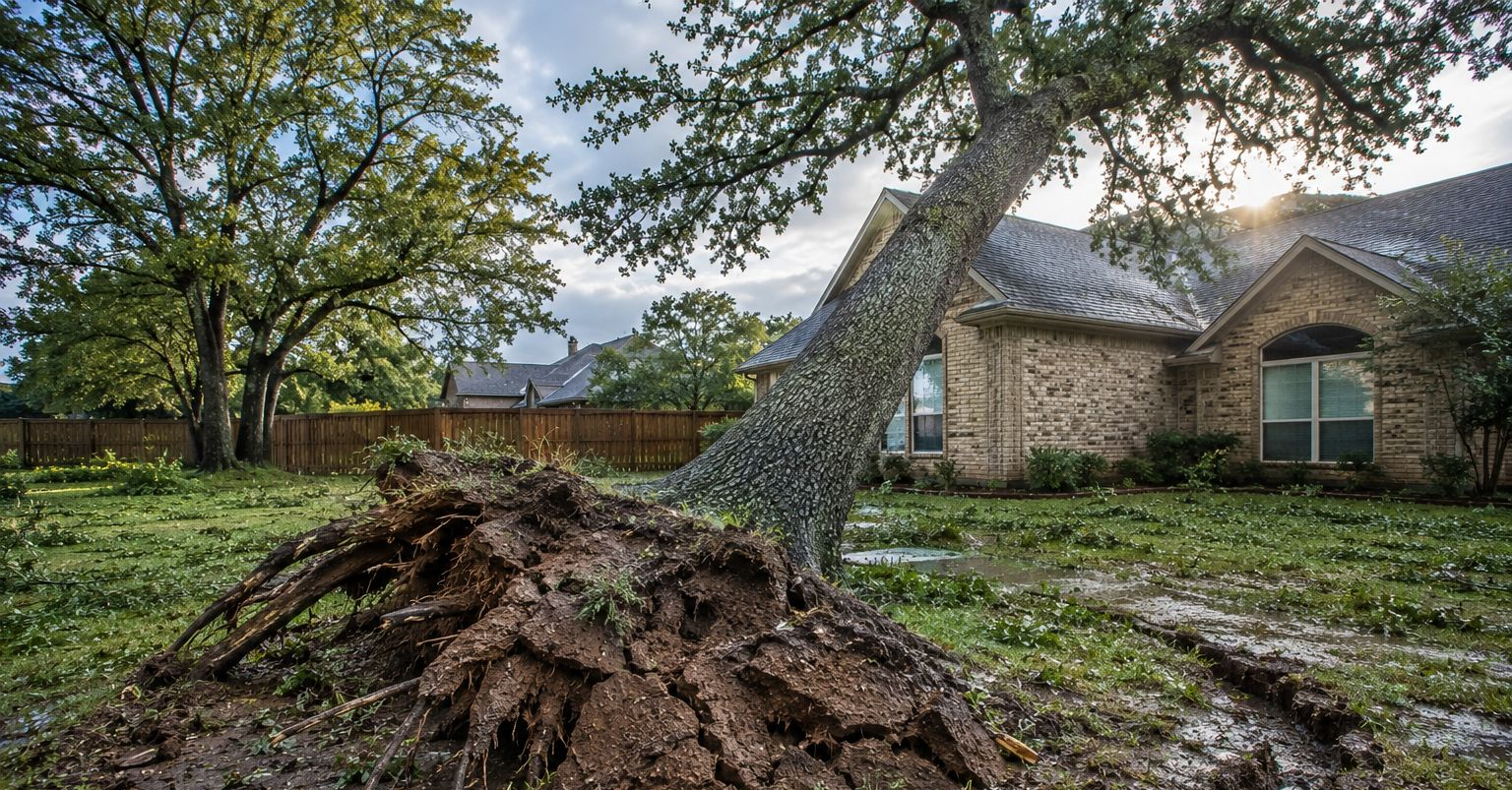
When the root plate lifts, it drags the soil with it. Look for a curved crack in the ground on the side opposite the lean, sometimes a foot or more out from the trunk, and for turf or dirt that looks heaved up or domed. That arc of disturbed soil traces the edge of the root plate as it rotates out of the ground.
Roots lifting out of the ground
On the high side of the lean, the side the tree is tipping away from, roots that used to sit at or below grade may now be exposed and pulling upward. Fresh soil clinging to lifted roots, or a gap opening between root and ground, points to a plate that has torn loose rather than one that simply grew shallow.
A base that rocks or a gap at the ground line
With larger trees you can sometimes see the trunk and root plate move together as a unit when the wind gusts, or find a widening gap where the base meets the soil on the leaning side. Movement at the base under load is one of the clearest signs the anchor is compromised.
Saturated ground under and around the tree
Storms in North Texas often mean the failure happened in wet soil. When the ground is soaked, the roots lose their grip and even a healthy tree can tip if the wind loads it hard enough. Standing water, mud, or a spongy feel around the base after a storm is part of the picture, because saturated clay holds a tree far less firmly than dry ground.
TIP: Mark the current lean before you do anything else. Photograph the trunk against a fixed background and press a stake or a bit of spray paint into the soil right at the base on the leaning side. If the tree keeps opening away from your mark over the next few days, the root plate is still moving and the tree needs eyes on it sooner rather than later.
Reading the Lean Angle and What It Signals
Not every lean is an emergency, and the angle helps you sort urgency. A slight, stable tilt on a tree with undisturbed soil is a different situation from a steep new lean over a hard target.
A lean past roughly fifteen degrees from vertical
Once a tree is leaning more than about fifteen degrees off straight, it is worth a professional look, especially if the tilt is recent. That is the point where the lean stops looking like character and starts looking like a load the roots may not be handling.
A mature tree leaning more than thirty degrees
A large tree tilted more than thirty degrees from vertical, or one that has partly uprooted with more than a few inches of root exposed, sits in the range where careful assessment for removal is the standard call. At that angle the anchor is badly compromised and the tree is carrying its own weight in the wrong direction.
A steep lean toward a hard target
Angle matters most when something valuable sits in the fall zone. A forty-five-degree lean out in an open pasture is a slow-motion problem. That same lean over a bedroom, a driveway where the car parks, or a power line is a reason to keep people clear and get it evaluated quickly, because the tree is aimed at the thing you least want it to hit.
WARNING: Do not try to pull a leaning mature tree upright or stake it back into place after a storm. Once the root plate has torn, hauling the trunk over with a strap or tractor tears more roots, can drop the tree without warning, and puts anyone nearby in the fall path. Keep people, cars, and pets out from under a freshly leaning tree, stay off the raised-soil side, and let a professional determine whether it can be saved or has to come down.
How an Arborist Reads a Leaning Tree
When a certified arborist looks at your tree, the work is part detective and part measurement, because the important damage is underground. The goal is to separate a stable old lean from a live failure and to weigh what sits in the fall zone.
The inspection starts at the base. An arborist checks for the arc of cracked or heaved soil, probes for a root plate that rocks under load, and looks for lifted or torn roots on the high side and buried, compressed roots on the low side. The trunk gets read for cracks, cavities, and old wounds that weaken it, and the crown is checked for the dead or unbalanced weight that adds sail area. The species, the soil, the recent weather, and any past digging near the base all feed the judgment.
From there the decision splits along clear lines. A young or lightly leaning tree in sound soil may be a candidate for correction or structural support. A mature tree with a torn root plate, a steep new lean, or a hard target underneath is usually one to remove under control before it fails on its own schedule. Where the tree can stay, thinning the canopy to cut wind load or adding support may be part of the plan. Where it cannot, planned removal takes the tree down in pieces, in a chosen direction, instead of letting the next storm decide.
Frequently Asked Questions
Is a tree that has always leaned dangerous?
Usually not on its own. A tree that grew at an angle built wood and roots to hold that shape. The danger sign is movement, so a lean that suddenly steepens deserves a check.
How can I tell if the roots failed or the tree just bent?
Look at the base rather than the trunk. Root failure shows as cracked or raised soil, roots lifting on the high side, and a base that rocks. A trunk bent in firm soil is less urgent.
Can a leaning tree be straightened and saved?
Sometimes, mostly with young or recently planted trees whose roots are still small. A large tree with a torn root plate straightens poorly, because pulling it upright tears more roots. Size and root damage decide the outcome.
Why did my tree lean after the storm when it never has before?
Storms combine two forces. Heavy rain saturates the clay soil and loosens the roots' grip, then strong wind loads the tree while the ground is softest. Drought-stressed or root-cut trees give way first under that combination.
How urgent is a tree leaning toward my house?
Treat it as urgent. A new lean aimed at a house or power line means the tree points at a hard target and the anchor is compromised. Keep people clear and arrange a professional evaluation quickly.
Should I stake or brace the tree myself until help comes?
No. Staking a leaning mature tree does not restore a torn root plate and can worsen the failure or trigger a sudden fall. Keep the area clear and let a professional decide on support or removal.
Reading the Warning Before It Falls
A tree that leans more after a storm is rarely random. Somewhere beneath the surface the root plate tore, the soil let go, or a long-stressed anchor finally gave under wind and rain, and the tilt you are looking at is the visible edge of that failure. The signs are readable if you know where to look: a lean that changed rather than one that always existed, cracked and heaved soil on one side, roots lifting free, and a base that moves. Match those against the angle and against what sits in the fall zone, and you can tell the difference between a tree to watch and a tree to act on. What you should not do is try to force it upright or wait out the next storm, because a compromised anchor only gets worse.
Have a leaning tree assessed before the next storm decides for you — When a tree tilts further after wind and rain, the answer is underground at the root plate, and reading it correctly is the difference between a tree that can be saved and one that has to come down safely. Serving Weatherford, Texas, Deadwood Services
inspects the base, soil, and roots, weighs the lean against what sits in the fall zone, and either stabilizes the tree or removes it under full control, with more than a decade of hazardous-tree experience and 8-plus five-star reviews behind safe, professional work. Reach out to schedule a
leaning-tree assessment
and get a clear, no-pressure plan for your property.